

To break through the professional ceiling and capture real revenue events like inquiries and booked calls, you need to change your entire approach: you need to focus on topics, not keywords.
Keywords are no longer the destination. They’re just the essential building blocks. This is how you win real search visibility: you build a holistic entity-based foundation that establishes your brand as the definitive source of truth for a whole concept.
The Core Paradigm: Keywords vs. Key Topics
We have to examine how modern search engines process information. Why is this shift mandatory? The historical battle of keywords vs. key topics is simply a matter of string matching versus concept understanding.
- Keywords (Strings): A string of text (e.g., “best financial software for physical therapy”) that is interpreted literally. If you optimize strictly for strings, you get these fragmented thin pages trying to capture every slight variation of a phrase.
- Key Topics (Entities): A topic is a conceptual node in a knowledge graph. It includes intent, context, and related concepts. When an engine like Google or an AI model processes a search, it converts the string of the user into an underlying entity to understand what they actually mean.
When you focus on topics, not keywords, you stop playing the lottery with search and start treating it like a science. Instead of creating five separate low-value blog posts for five micro-keywords, create one authoritative pillar page that covers the entire topic node. This richness of meaning signals to search engines that you have the baseline coverage needed to be trustworthy of user attention. The focus needs to shift here if you want to stay visible as AI discovery becomes the new first page.
Advanced SEO Competitive Intelligence in the AI Era
SEO competitive intelligence used to be easy. You’d take a competitor’s URL, toss it into a tool, see the top keywords they rank for, and write a slightly longer version of their text.
That strategy is completely dated in a semantic search landscape. Competitors are no longer just other websites that are ranking on page one. Your competitors are the AI search summaries themselves, which can eat up organic traffic if your content doesn’t provide unique value.
Modern competitive intelligence means looking at how search models cluster information around your competitors. To get to the real value, you have to feed your competitor insights through a dedicated search engine marketing intelligence framework. You must ask:
- What core entities is the competition associated with?
- What specific proprietary insights are they missing?
- Where is the "Context Gap" between what the user is asking and what the competitor is repeating?
Auditing the competitive landscape at the topic level allows you to find empty spaces in the market – where competitors are relying on generic, commodity copy rather than expertise. That tells you exactly where to slot in your own high-value frameworks to upset their rankings.
The Blueprint: The Best Way to Find SEO Entities
If search engines are reading the web through entities, then your content strategy has to be built on those same nodes. But how do you get away from basic keyword tools to find them?
The best way to identify SEO entities is to draw data directly from the semantic engines. Here is a multi-step workflow:
Step 1: Extract Google Natural Language API Data
Before you write a single word, run your core seed topic through natural language processing (NLP) tools. This allows you to see exactly how an engine breaks down text into entities, categories, and sentiment. It gives a window into exactly what noun-phrase relationships the algorithm expects to see.
Step 2: Analyze Wikidata and Wikipedia Relationships
Google’s knowledge graph is closely connected to open-source semantic databases like Wikidata. Search these databases for your main industry topics to find their explicit links. If you are writing about a financial service, consider what other nodes are structurally related to that one (tax compliance, cash flow tracking, regulatory frameworks, etc.).
Step 3: Parse "People Also Ask" and Generative Summaries
Detect conceptual patterns in Google AI Overviews and PAA loops. These elements show the real-time associative jumps that the models make. If a user searches for topic A, what is the immediate sub-topic B that the engine surfaces?
Mapping these nodes provides a blueprint for building out advanced SEO and AI search infrastructure that perfectly aligns with an engine’s pre-existing conceptual frameworks.
Deconstructing the Content Audit: Beyond the Spreadsheet
Most content audits provided by old-school agencies are fundamentally flawed. They look like a massive spreadsheet of URLs, meta descriptions, and pageview counts, often with a generic recommendation to “add more keywords.”
A full content audit by an SEO company should be a diagnostic analysis of your site topical authority. It needs to look at your content library through one lens only: Is this library validating us as an unassailable source of truth, or is it just a collection of disparate pages?
When making a strategic overhaul, working with specialists for expert SEO services ensures that every page is correctly categorized into a specific action layer:
- Prune: Remove or redirect old, thin pages targeting old keywords or overlapping existing topical footprints. These pages dilute your site’s overall authority and waste crawl budget.
- Consolidate: Take several short articles with slight variations on a keyword and combine them into one all-encompassing powerhouse page that dominates the master topic.
- Content Upgrade: Identify which foundational pages are performing well, but could benefit from a content upgrade to take them from basic info page to elite asset with proprietary research and unique case studies.
Architectural Precision: The Importance of Keyword Mapping
You can choose to focus on topics and not keywords, but structural organization is the key. And here is where the keyword mapping becomes important.
What not to do with keyword mapping: One phrase, one URL. The architecture of the process of mapping specific intents and sub-topics to their suitable positions within a hierarchy of intentional content.
Strategic mapping is essential; without it, a website will inevitably suffer from topical cannibalization – multiple pages competing against each other for the same semantic space, confusing search engines and diluting your visibility. If you have been running aggressive paid campaigns alongside organic growth, poor mapping is also going to mess up your tracking, which is why your paid media isn’t scaling.
The Hub-and-Spoke Architecture
The most effective way to map your semantic framework is through a rigorous Hub-and-Spoke (or Topic Cluster) architecture:
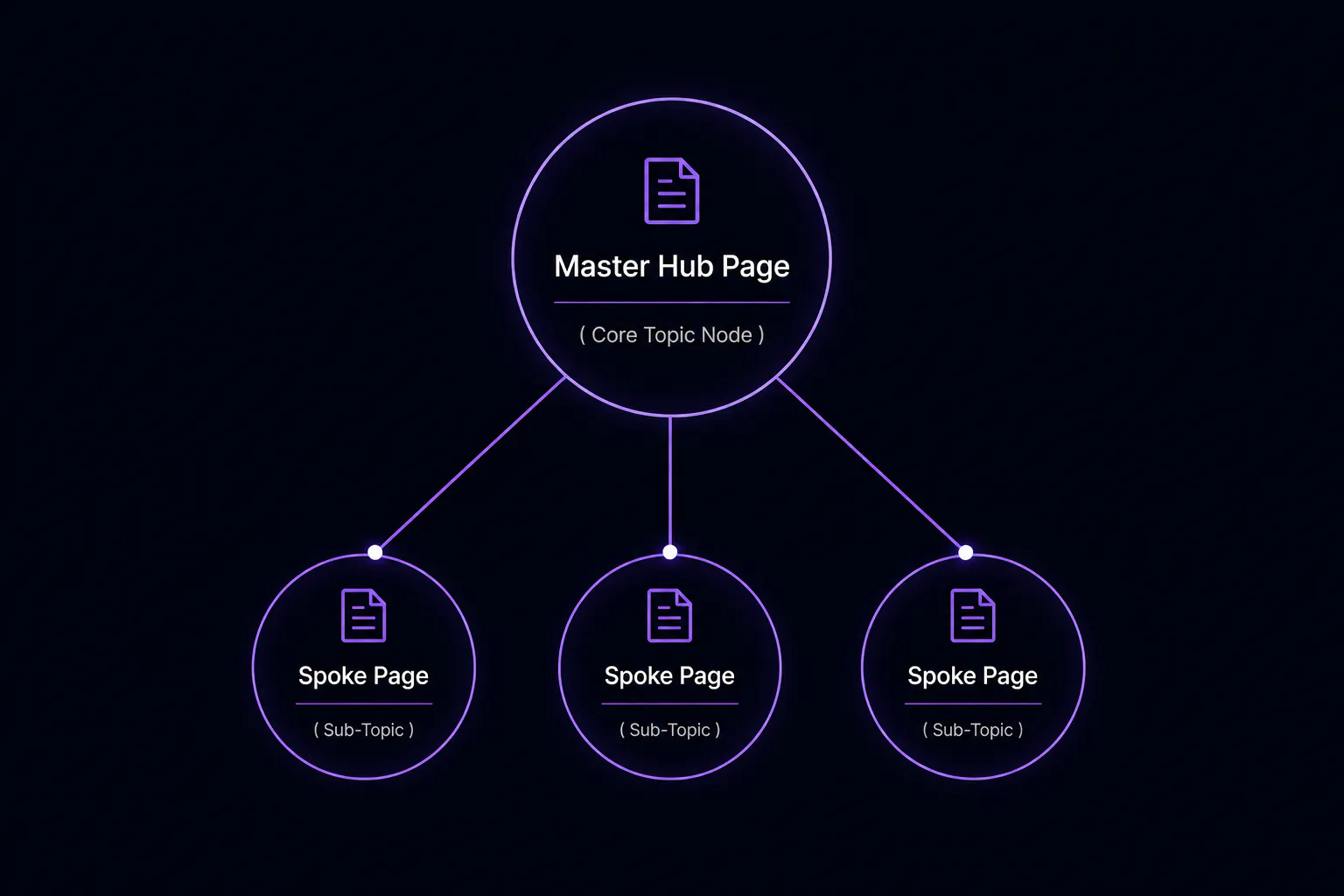
- The Hub Page: A pillar asset that is comprehensive, high-level, and delves deep into a broad topic node. It targets your conceptual master head terms and is the anchor of the structure.
- The Spoke Pages: In-depth articles that branch out from the hub page to fully address particular sub-topics, long-tail queries, and related entities.
- The Semantic Interlinking: Each spoke page should link back to the master hub with a clear contextual anchor text, and the hub should link down to the spokes. This internal linking structure naturally distributes topical relevance across your domain, letting algorithms know precisely how your content relates.
The Finish Line: Executing a High-Value Content Upgrade
Once your structure is mapped and your audit is complete, you need to execute at the page level. Your pages can’t look like commodity AI copy to break past the baseline entry fee of search visibility and earn preferred citations.
To make a content upgrade work, inject your text with three pillars of real-world authority:
A. Prioritize Information Gain
Information Gain is the most visible signal for modern discovery engines. If your page is just an echo of what are currently the top 5 results on Google, there is no reason for an LLM to cite you. You are asked to contribute new data, proprietary frameworks, unique infographics, or counterintuitive industry insights not available anywhere else on the web.
B. Demonstrate E-E-A-T
Your content must clearly demonstrate E-E-A-T (Experience, Expertise, Authoritativeness, and Trustworthiness). Do not write in an anonymous, detached corporate voice. Deep-dive case studies (like our Flychain organic growth results) to prove real-world authority. Reference your own workflows. Quote internal subject matter experts. Make sure your authors are clearly identifiable entities.
C. Build Deep Cross-Platform Context
Rarely does real model authority come just from your own domain. Search engines and LLMs crawl the wider web for cross-platform corroboration. Pair your on-site topical pillars with targeted digital PR, high-authority guest placements, and organic discussions across networks like LinkedIn and Reddit, and you’ve created a high-confidence association that cements your brand as the definitive authority.
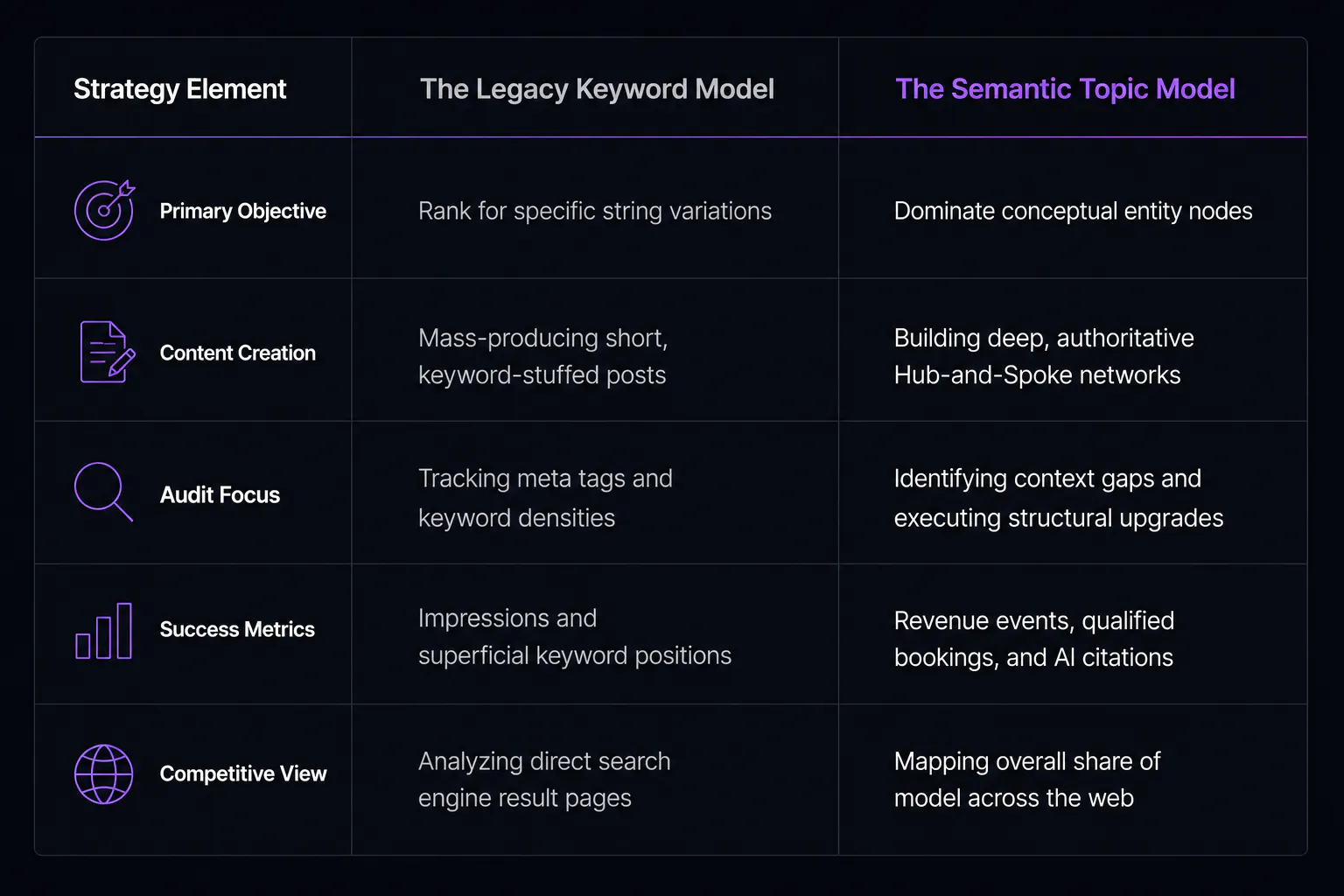
The Search Intelligence Framework: A Comparative Summary
To see how shifting away from keyword chasing fundamentally changes your day-to-day marketing execution, contrast the legacy model against an integrated Search Intelligence framework:
Ready to transform your content from basic keyword targets into an elite growth engine? Move past the starting blocks and contact Sprintli Studios to build an authoritative semantic footprint.
