

For founders, CEOs, and growth strategists, this raises an important question: Does SEO content marketing still matter in an age of AI answers and generative search summaries?
The answer is an emphatic yes, supported by data — but the paradigm has shifted completely.
Content marketing is not just relevant; it is the single most important variable separating brands that are actively cited by modern search networks from those that are being rendered completely invisible. The old way of thinking of content as just a mechanical filler of word-count is, however, dead. Today, Search Engines and Answer Engines (like ChatGPT, Claude, Perplexity, and Google AI Overviews) are hitting a huge “Authority Tax”.
Specialized seo content writing services can help your brand become an elite engine that goes beyond basic informational output. This will help you win top-of-screen visibility, tap into high-intent demand, and defend your long-term organic revenue pipelines.
1. The Reality Check: Why Content Marketing is Crucial Right Now
To understand the importance of content marketing in 2026, we have to look directly at how search engine architectures have adapted to the explosion of generative data.
When Google launched AI Overviews globally, early industry panic said “zero-click searches” would kill the economic viability of organic traffic. For high-authority brands, however, the reality has been just the opposite.
Search research firms’ broad index tracking reveals that generative summary boxes now trigger on about 48% of all tracked commercial and informational queries, a huge 58% year-over-year increase. So a standard AI Overview box is about 1,200 pixels tall vertically. Which means it pushes legacy, blue-link organic results completely below the fold in the desktop viewport.
This structural layout shift completely rewires the mechanics of organic CTR. A commercial search with an AI summary at the top results in an immediate 26% to 34% drop in clicks on the number one traditional organic listing.
This isn't just a formatting shift; it's an algorithmic wall that requires you to actively rethink how you structure assets, forcing brands to systematically optimize content for Google AI Overviews to capture visibility before the fold.
In addition, as many as 64% of generic informational searches now result in “zero clicks,” with the machine answering basic questions right on the results page.
AI Overviews are actively capturing top-of-screen viewport real estate. Don't let your search footprint vanish below the fold. Let’s look under the hood of your site and map out a strategy to claim your inline citation links. 👉 Claim Your Free AI Search Assessment
The Citation Marketplace
So where are those clicks going? They're going directly into the citation loops that are baked into the generative answers themselves. In an AI synthesis box, the reply is pulled from trusted nodes across the web. These inline citations are clicked on by users for deep commercial or technical queries about 41% of the time when validating.
This means that search optimization is no longer about winning a superficial listing position but about becoming the fundamental source data that the LLM is forced to reference.
The true structural benefits of content marketing in this ecosystem are clear:
- Algorithmic Training Feeds: Large Language Models do not generate facts in a vacuum, but require ongoing training on credible public data to provide accurate responses. If your site doesn’t have deep, original topical footprints, you are not in the model’s retrieval graph.
- Capturing the Messy Middle: Modern enterprise and service-based buyers are on highly non-linear research journeys. Expert content is a continuous organic net that catches prospects at many touchpoints before they ever speak to a sales rep.
- A Self-Sustaining Conversion Asset: Unlike paid advertising channels, where customer acquisition costs grow linearly with budget, an elite repository of authoritative assets drives compound organic returns long after the initial creation phase concludes.
So where are those clicks going? They're going directly into the citation loops that are baked into the generative answers themselves. In an AI synthesis box, the reply is pulled from trusted nodes across the web. These inline citations are clicked on by users for deep commercial or technical queries about 41% of the time when validating.
2. The Great AI Slop Collapse: Why Commodity Text Fails
There’s a huge flaw in the strategy of brands looking to scale organic visibility by flooding their domains with automated, unedited AI output. Here’s the crux of the matter when it comes to today’s discovery engines: Google, social networks, and Answer Engines know exactly when content is being created without human supervision.
Using raw AI output doesn’t move the needle as it violates the basic criteria needed to build trust in modern indexing pipelines. Automated text is non-original by design – it samples from the pre-existing data in its training set, producing low-signal, generic copy that has zero Information Gain.
Automated content scaling collapses under algorithmic quality filters. If your site is weighed down by generic, look-alike copy, it’s actively draining your crawl budget and suppressing your rankings. 👉 Audit Your Site with Sprintli’s Growth Team
The 16-Month Search Automation Case Study
If you want to see the kind of effect automation-powered content strategies can have in the wild, look no further than a pioneering 16-month experiment in search engines that meticulously tracked the lifecycle of 2,000 fully automated, unedited informational articles over 20 different domains.
The technical course of that indexation is a stark warning tale:
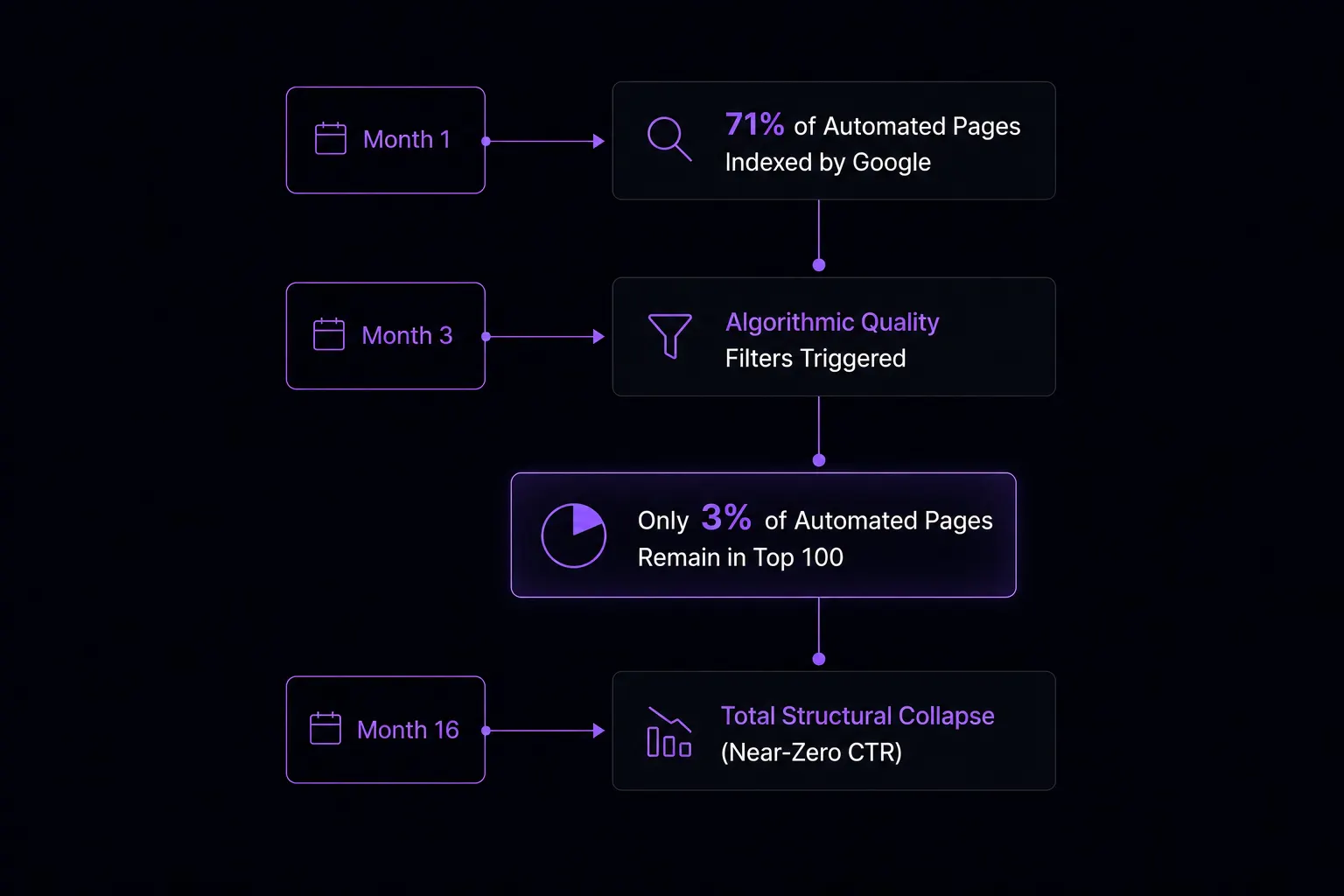
In the first 30 days, the algorithms initially indexed about 71% of the machine-generated pages. The complete lack of real-world authority and structural expertise, however, triggered deep algorithmic quality filters. 97% of the 2,000 automated pages have fallen out of the top 100 positions within three months. After more than a year of constant tracking, the entire automated footprint fell into total algorithmic irrelevance, resulting in a click-through rate so nonexistent as to be nonexistent.
LinkedIn's Algorithmic Stance Against AI Slop
This algorithmic rejection is not just for search engine crawlers. Major professional distribution networks have re-engineered their delivery engines to throttle automated text actively.
In fact, the engineering and product teams at LinkedIn have directly tinkered with their core feed algorithms to specifically target and downgrade blocks of generic content generated by AI. The modern distribution framework of the professional network clearly favors “first-person insights, verified professional experiences, and distinct expertise.”
The platform’s algorithmic filters serve to reduce the velocity of distribution of templated low-signal automated text pulled from a corporate profile or personal account, thereby distinguishing real authority from automated distribution networks.
When a domain relies entirely on regurgitated knowledge graphs, algorithmic updates quickly flag the footprint as redundant—proving why your startup's SEO strategy is already obsolete if it is still anchored to the rules of 2024 metric systems.
3. The Union of Science and Art: SEO and Copywriting
The old split between technical SEO optimization and high-level creative writing has utterly vanished. Search optimization requires both technical compliance and a unique human authority. The art of navigating modern organic growth is a deliberate synthesis. seo and copywriting work as a single unified system.
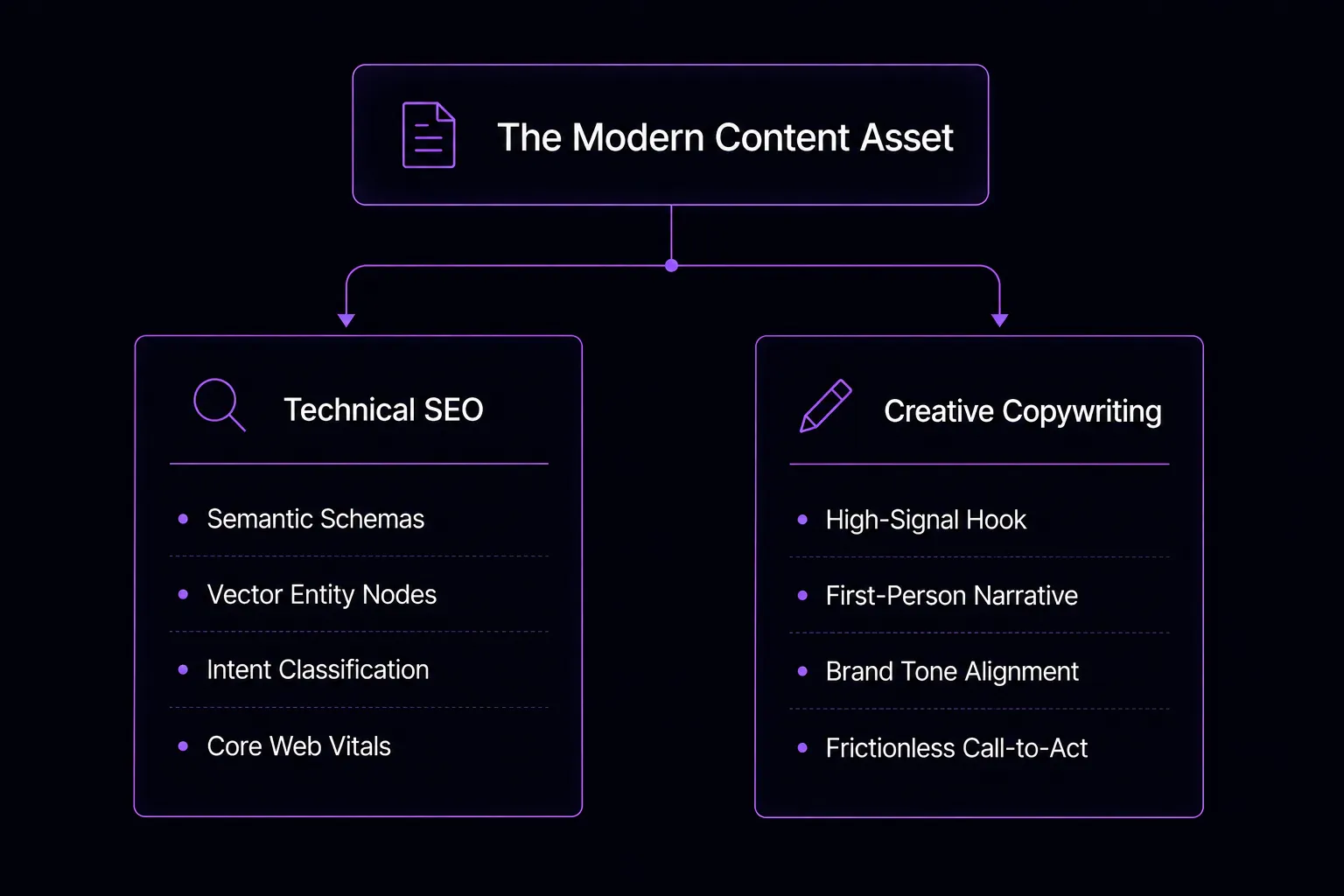
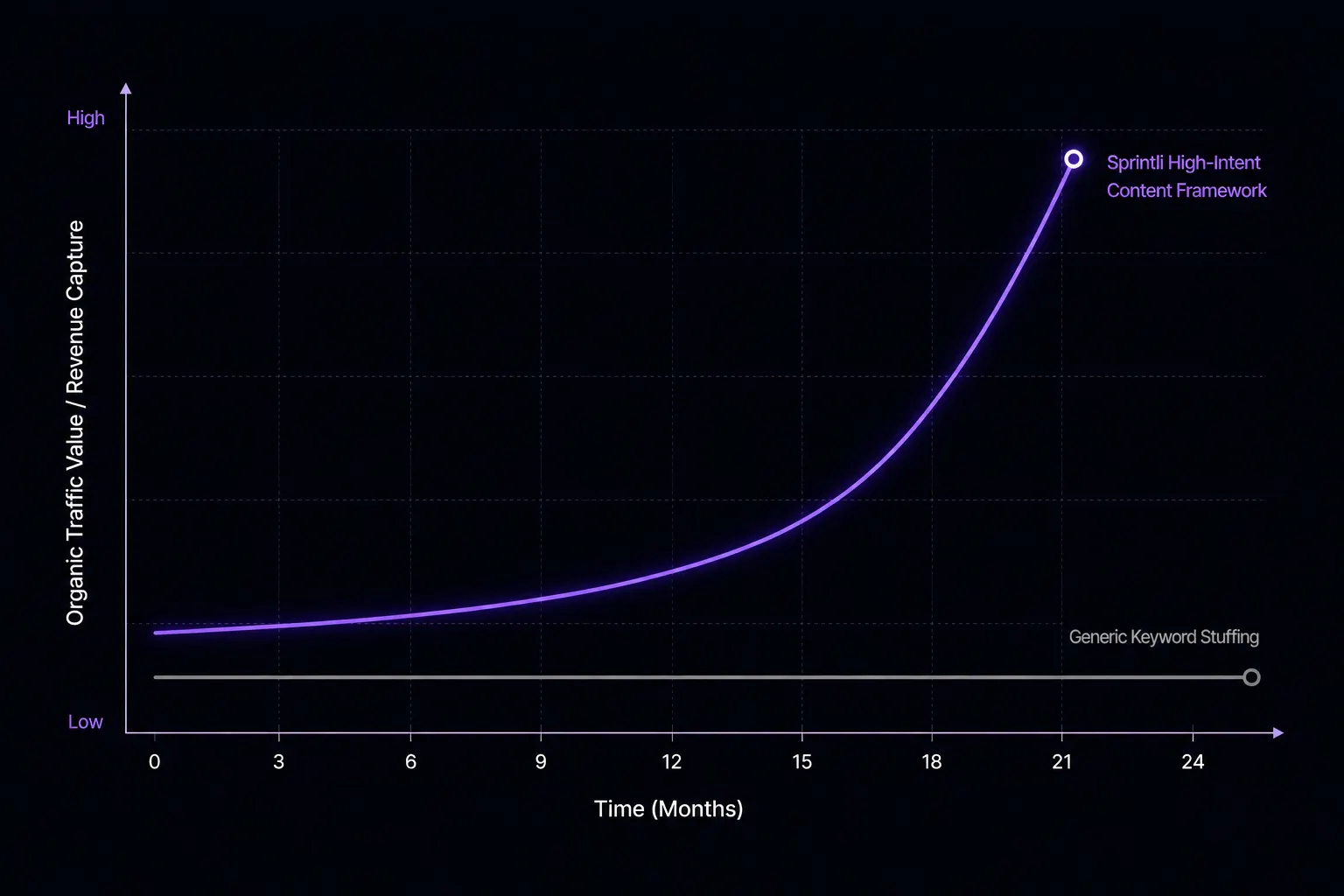
Instead of focusing on shallow vanity metrics, this approach shows how high-intent vertical optimization turns an organic content library into an absolute revenue machine. Hyper-focused execution captures dominant market share.
5. Deconstructing the Architecture: Elite Content Auditing
Before you build an authoritative topical footprint for the future, you need to do a thorough assessment of the current technical debt spread across your existing domain. This is where a comprehensive SEO content audit becomes a business imperative.
To execute a clinical diagnostic of your site’s true footprint, you have to run your existing URLs through a framework driven by advanced search engine marketing intelligence rather than relying on surface-level keyword auditing spreadsheets.
A high-performance audit from a top-tier growth studio doesn’t touch surface-level checklist parameters at all. Instead, it systematically considers your entire body of work through a rigid architectural filter.
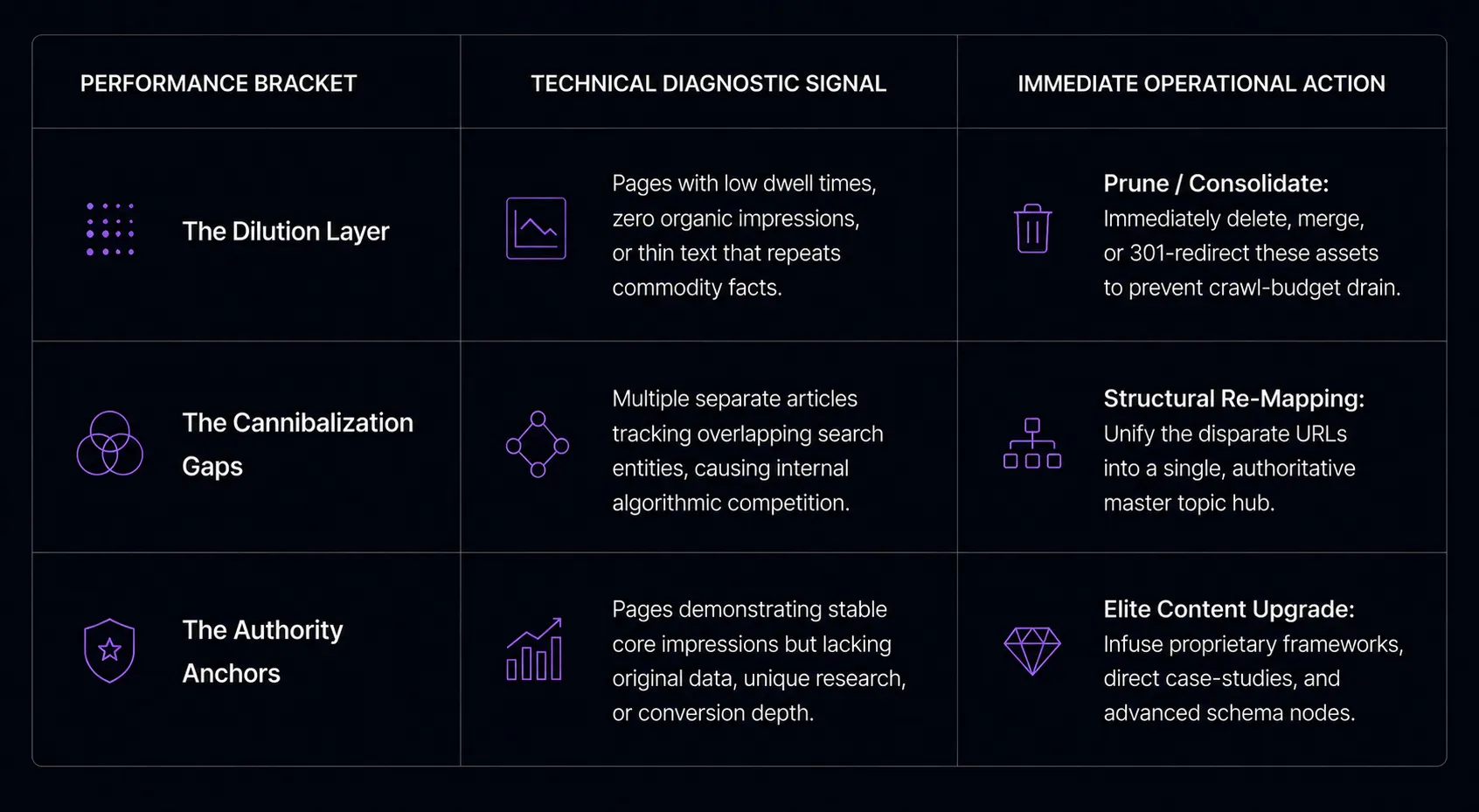
The Topical Capitalization Matrix
Your entire domain footprint is evaluated using three core technical performance vectors for a professional audit:
The Blueprint of an Elite Content Upgrade
If you pick a poor-performing page for an asset upgrade, you don’t simply add another 500 words of introductory fluff. To really upgrade the algorithm, you need to deliberately put in some markers of hard credibility:
- Verifiable E-E-A-T Anchors: Add exact author credentials, expert consensus citations, and direct peer-review references.
- The AI Citation Shield: Rework the core definitions in the text so you have crisp, definitive, single-sentence answers wrapped in clean semantic HTML tags (`<h2>` and `<p>`), making it structurally seamless for an Answer Engine to parse and scrape your brand as a primary source citation.
- Structured Schema Infrastructure: Deploy rich schema structures directly into the page source code that explicitly define relationships between your brand name, your executive authors, and the target concepts addressed in the text.
Traditional checklist audits won't protect you from topical cannibalization or crawl-budget drain. Run your existing library through an expert operational diagnostic to isolate gaps and prepare your site for AI-readiness. 👉 Schedule an Expert Content Audit
6. Maximize the Content Engine: Repurposing & Lead Generation
Elite organic content libraries should be multi-channel. If you want to get the most ROI out of your creative investments, your core content repository needs to be the main fuel source for a multi-platform distribution system. That’s where an advanced AI content repurposing strategy delivers compounding value.
The goal is simple: Take a master topical anchor page, human-authored, that contains your proprietary data and use AI as an operational distribution lever to fragment that core asset into a distributed multi-channel network.
By keeping your core thought-leadership human, you can scale your cross-platform content velocity with automation without ever diluting your brand’s perspective or compromising your rankings within modern SGE, AEO, and GEO search standards.
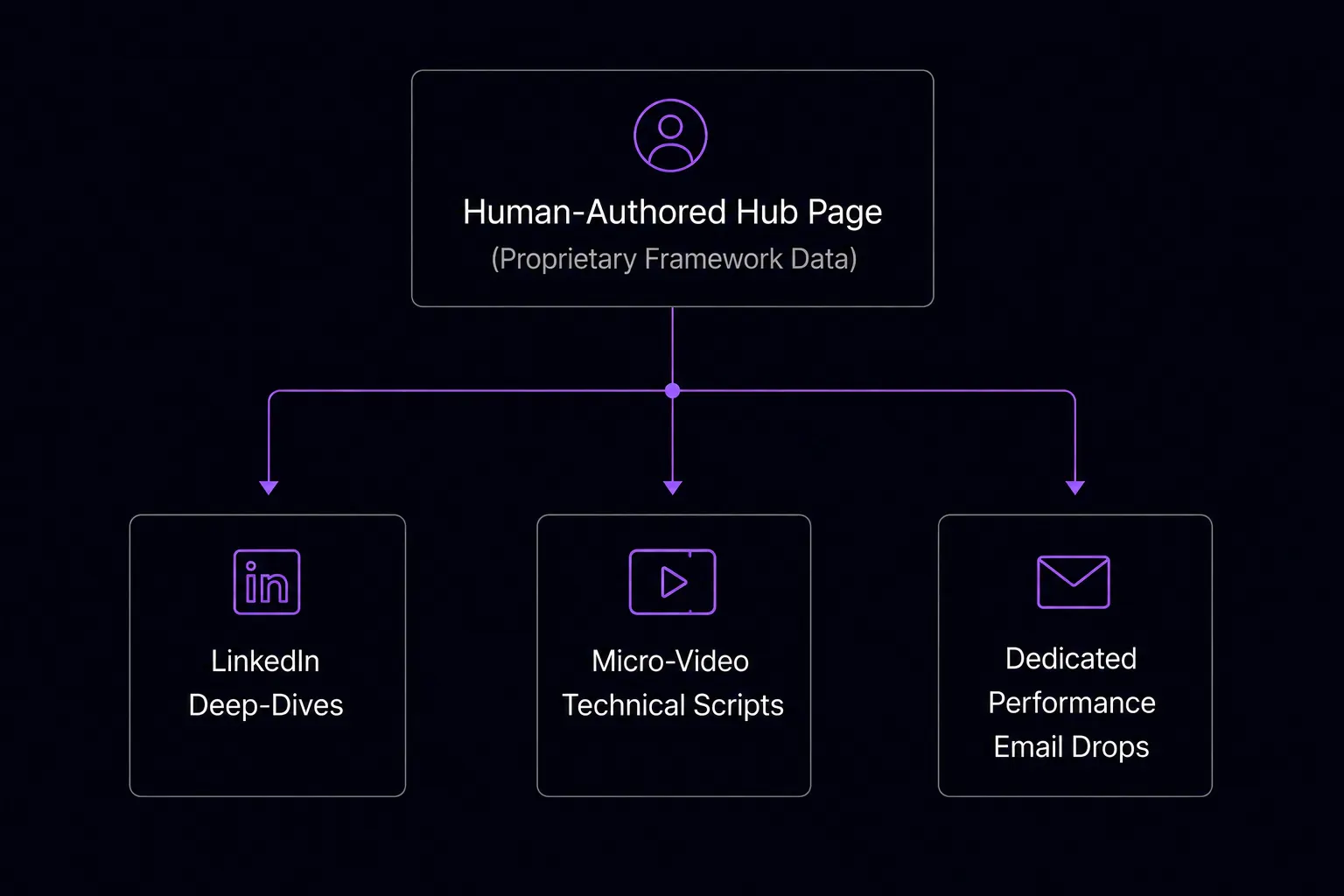
If you’re using generative tools just as a formatting accelerator for your own unique ideas (not for the thinking), then you maintain full strategic control over your brand’s perspective, while executing at an elite pace.
Stop burning resources on disjointed, ad-hoc posts. Build an authoritative human anchor page, then leverage AI strictly as an operational distribution accelerator across LinkedIn, micro-video, and targeted email drops. 👉 Deploy an Automated Distribution Framework
Driving Real Revenue Events: Content Marketing Lead Gen
The acid test for any organic investment at the bottom of the funnel is its ability to consistently produce qualified business opportunities. High-signal content marketing lead gen avoids generic, gated ebooks that regurgitate surface-level information.
Instead, high-converting service content marketing fills the gap between educational discovery and commercial intent by providing your audience with specialized, high-value toolkits:
- Interactive Operational Frameworks: Give prospects downloadable custom spreadsheets or working technical templates that they can plug into their workflows immediately.
- The Sprintli Strategy Matrix: Clear tactical comparison charts that visually show the impact of various operational strategies on a client’s performance efficiency.
- Proprietary Calculation Engines: Integrate sleek web tools that will allow users to accurately calculate their internal operational bottlenecks right on your page.
7. The Performance Calculus: Measuring Content Marketing ROI
Vanity metrics like surface-level impressions, organic traffic volume, and arbitrary search keyword position are totally irrelevant to founders and technical strategists managing growth budgets. All success criteria for a premium content distribution asset should be based on performance-driven, revenue-first metrics.
To calculate true content marketing ROI, you need to measure how your organic library improves acquisition efficiency across your entire ecosystem.
The Growth Engine Compounding Matrix
To understand the financial impact of a unified content engine, consider how your organic authority affects the ROI of your paid media investments and your clients’ conversion rate:
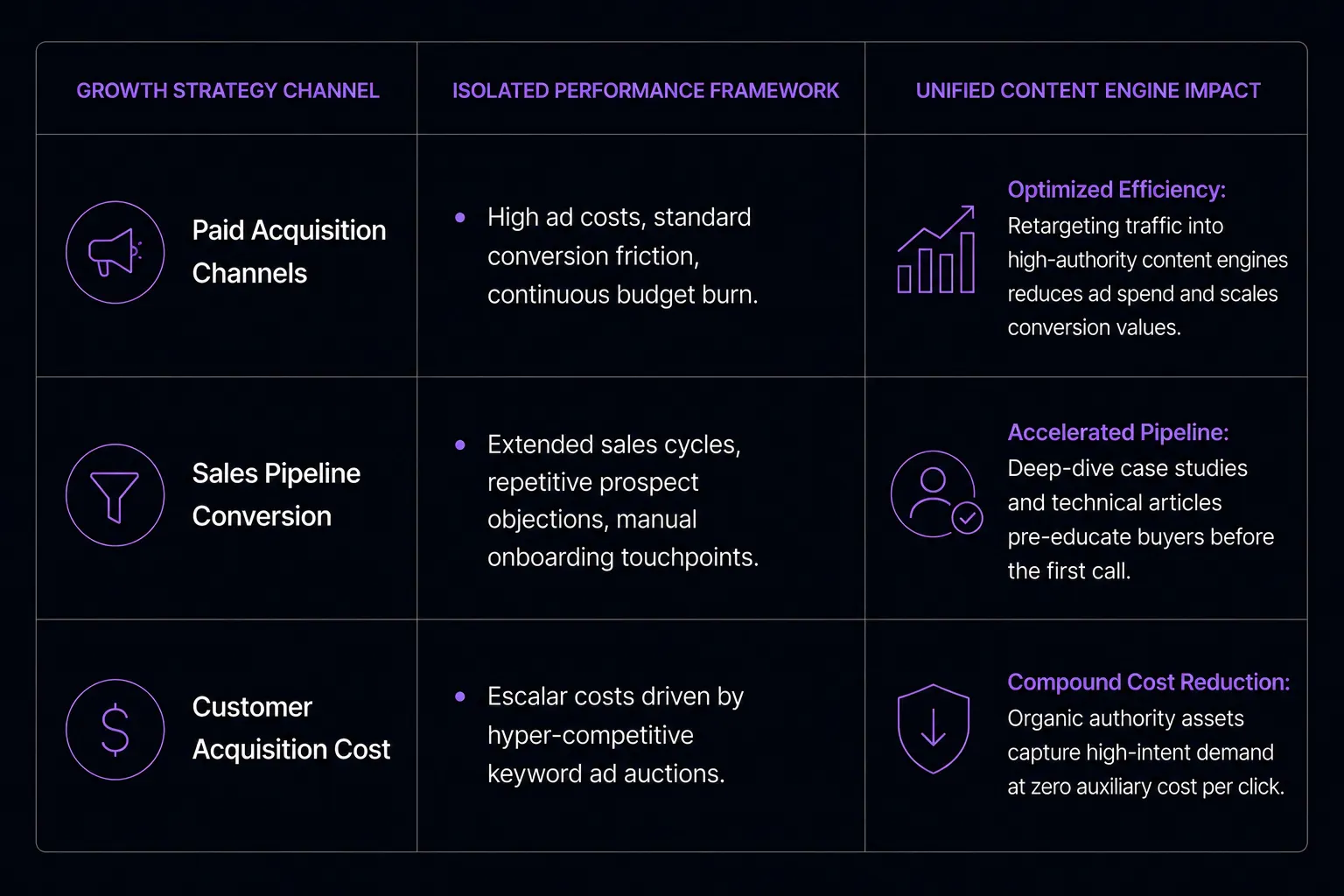
By treating content marketing like science, not just writing, you create a lasting digital asset that builds corporate value continuously, protects your domain from changes in the search landscape, and scales your revenue engines.
Stop managing your ads and organic channels in silos. Let’s align your paid acquisition budgets with a dominant semantic footprint to slash your customer acquisition costs and accelerate conversion paths. 👉 Partner with Sprintli Today
