

What Does AIO Stand For?
AI Overviews is what AIO stands for in the world of modern search. These are the generative responses that Gemini puts together to quickly answer complicated user questions. They show up at the top of Google Search results. Being included in these overviews is the new "Position Zero" for B2B SaaS and tech startups.
What Do Google AI Overviews Actually Look Like?
To understand how to improve visibility in Google AI Overviews, it helps to look at what actually gets selected — not just what gets published.
Below is a real AI Overview result we achieved for one of our clients.
Query: "medical accounting software"
AI Overview Result:
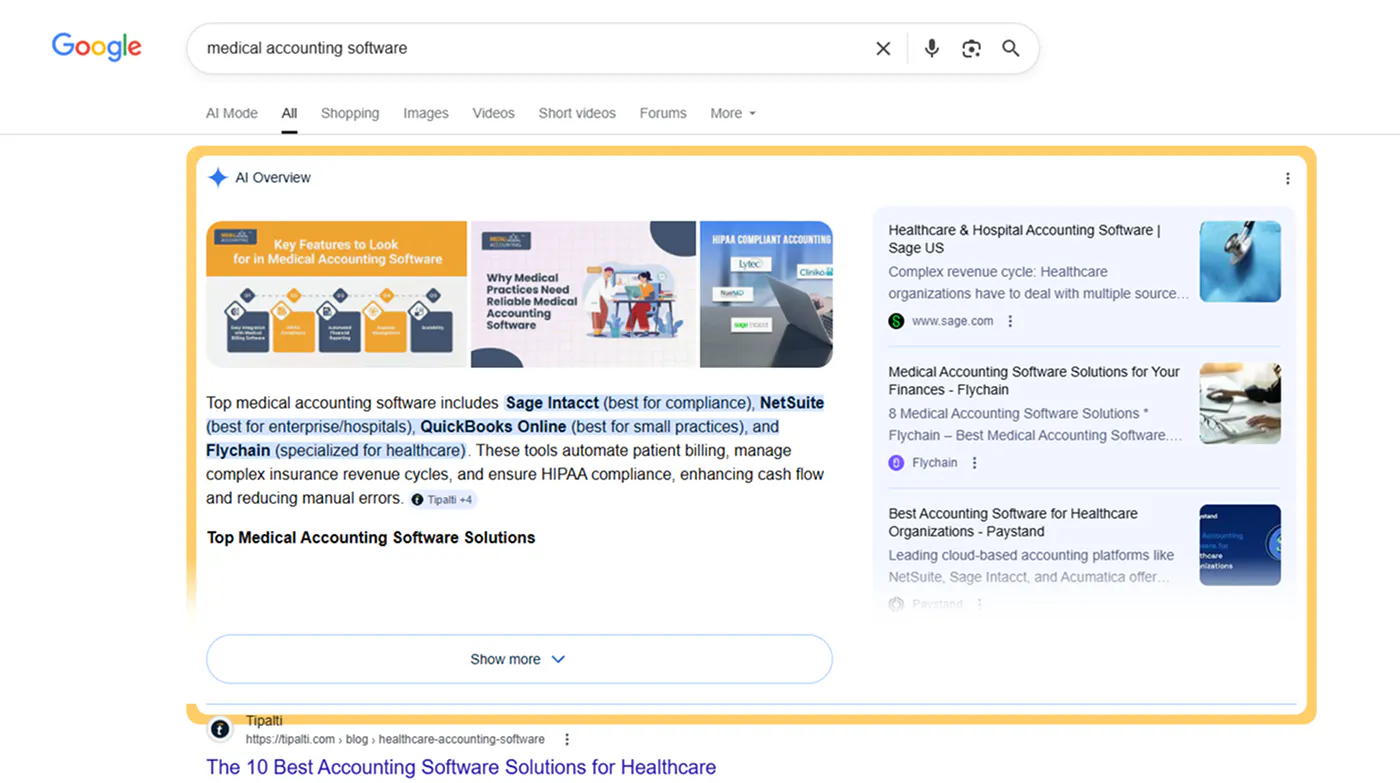
This is one of 72+ AI Overviews we’ve generated for Flychain — and counting.
What makes this result particularly notable is the context.
For this query, Flychain is being surfaced alongside established platforms like Sage, NetSuite, and QuickBooks — despite being a relatively new player in the market.
In traditional SEO, this level of positioning would typically take years of authority building.
In AI-driven search, it can happen much faster — if the content is structured, contextualized, and aligned with how AI systems evaluate relevance.
From an AI overview optimization perspective, this typically occurs when:
- The content directly answers the core query with high clarity
- The page reinforces strong topical alignment (e.g., healthcare + accounting + software)
- The brand is consistently associated with the problem being solved
This is the shift most teams miss.
You're no longer competing purely on domain authority.
You're competing on how well your content can be understood, selected, and trusted by AI systems.
And when that happens, even early-stage companies can appear alongside industry leaders.
The Issues: Why Your Current Strategy is Failing
Most companies are still using a 2023 playbook in a 2026 world. This leads to three critical points of failure:
- The Context Gap: Traditional SEO focuses on keywords, but AI search focuses on intent and entity relationships. If your content doesn't explicitly solve a specific problem, the AI will skip it.
- Information Density: AI models prioritize "high-signal" content. Fluffy, 2,000-word blog posts that take forever to get to the point are being filtered out in favor of structured, authoritative data.
- Lack of Technical Schema: Without the right underlying measurement and analytics or structured data, Google’s LLM cannot "read" your authority effectively.
The Missed Opportunity: The Growth Potential of AIO
A lot of people are scared of AI search because it doesn't require any clicks, but there is a huge opportunity for B2B SaaS marketing. When someone sees your brand mentioned as a source in an AI Overview, they are much more likely to trust it than they are to see a regular ad.
When you use the best AI search optimization techniques in 2026, you're not just getting "traffic." You're also getting pre-qualified leads who have already seen Google's own AI validate your solution.
Best Practices for Optimizing Content for Google AI Overviews
To maintain and grow your footprint, you must shift toward AI Search Optimization (AIO). Here is how to stay ahead:
1. Direct Answer Architecture
Google AI Overviews look for clear, concise answers to specific questions. Use a "TL;DR" approach at the beginning of your technical articles. This makes it easier for the model to scrape your conclusion and cite you as the primary source.
2. Implement Advanced Schema
AI needs to be organised. It's no longer optional to use a good schema generator to describe your business, products, and frequently asked questions. It connects your raw text to what the AI understands.
3. Focus on "Brand Citations"
Becoming a cited authority is one of the best ways to make your brand more visible in AI search results. This means writing original research, case studies—like our work with Flychain—and technical documentation that other people use.
4. Optimize for Natural Language
People use different words when they talk to AI than when they type into a search bar. Your SEO and AI search strategy needs to include long-tail, conversational questions that start with "How do I..." or "What is the best way to..."
How to Structure Content for Google AI Overviews
To improve visibility in Google AI Overviews, content must be structured in a way that AI systems can easily extract, interpret, and recombine.
A simple but effective structure looks like this:
1. Direct Answer Block (1–2 sentences)
→ Clearly answer the primary query upfront.
2. Supporting Expansion
→ Provide context, examples, or variations of the answer.
3. Entity Reinforcement
→ Mention relevant tools, brands, or concepts naturally.
4. Optional Depth Layers
→ FAQs, comparisons, or step-by-step breakdowns.
Sprintli Pro-Tip:
The Information Gain Factor In 2026, google ai overview seo isn't just about repetition. Google’s "Diversity Ranking" algorithm filters out content that simply mimics existing sources. To truly optimize content for google ai overviews, you must provide "Information Gain"—unique data, a proprietary case study, or a contrarian expert opinion that the AI hasn't seen elsewhere.
This structure increases the likelihood that your content is selected, summarized, and cited inside AI-generated responses.
Most brands fail here — not because of poor content, but because their content isn’t machine-readable at a structural level.
What is AI Overview Optimization (and Why It’s Different from SEO)
AI overview optimization is not just traditional SEO with new terminology — it is a shift in how content is evaluated and surfaced.
Traditional SEO optimizes for:
- Rankings
- Keywords
- Backlinks
Google AI Overview SEO focuses on:
- Answer quality
- Context completeness
- Entity relationships
- Citation eligibility
This means your content is no longer competing for a position — it is competing to become the answer.
Brands that understand this shift are seeing disproportionate gains in visibility, even without ranking #1 in traditional search results.
Strategies for Optimizing Content for Google AI Overviews: The Sprintli Way
At Sprintli, we don't just "do SEO." We build growth engines for startups that are native to the AI era.
To win in 2026, you need a mix of advanced conversion rate optimization (CRO) and a lot of technical knowledge. We help technical founders and marketing teams deal with this change by:
- Audit and restructuring legacy content for AI discoverability.
- Deploying custom LLM tools to analyze how AI perceives your brand.
- Integrating AIO visibility with paid acquisition to capture demand at every stage of the funnel.
How to Actually Improve Visibility in Google AI Overviews
At this point, the question isn’t whether AI Overviews matter — it’s how quickly you can adapt.
There are two ways to approach this:
1. DIY Approach
Use structured tools to audit and improve your content:
- Schema generation for entity clarity
- Metadata optimization for better extraction
- LLM visibility testing to see how AI interprets your brand
2. Strategic Implementation
For teams that want to move faster, this requires a full content and technical restructuring approach — aligning SEO, CRO, and AI visibility into a single system.
Most companies underestimate how much of their existing content is invisible to AI systems.
That’s where the opportunity is.
Conclusion: Don't Get Left Behind
The search landscape has changed from "finding links" to "finding answers." To effectively optimize content for Google AI overviews, you need a partner who knows the technical details of AI visibility and GEO.
Are you ready to take your place in the AI Overviews? Get in touch with Sprintli today and let’s build your 2026 growth roadmap before it’s too late.
