

The Evolution of the Search Generative Experience
The "Blue Link" was the most important thing in SEO for 20 years. That time period officially ended in 2026. The widespread use of Search Generative Experience (SGE), which is now well-known to users through AI Overviews, has completely changed how people interact with information. You need to read our in-depth article on AI Overviews to understand how SGE in SEO has changed from a beta test to the main way people search with high intent.
What is Search Generative Experience?
Google's Search Generative Experience is an AI-powered interface that uses Large Language Models (LLMs) to put together complicated answers right on the search page. Search Generative Experience gives you the destination itself, while traditional results only give you a list of places to go. This means that for B2B SaaS and Fintech companies, your "Visibility" is now based on whether the AI uses your data or ignores it.
The Technical Mechanics of SGE SEO
To win in 2026, you must move beyond keywords and into "Entity Mapping." SGE SEO is less about "matching" a query and more about "resolving" an intent.
How to Rank in SGE: The RAG Framework
Google’s Search Generative Experience utilizes Retrieval-Augmented Generation (RAG). When a user types a query, the model retrieves the most "authoritative" and "structured" data nodes to build its response.
- Verifiability Over Visibility: You can rank #1 in the traditional SGE SERP but be completely excluded from the AI Overview if your content lacks structured "Proof Points."
- The "Zero-Click" Reality: Because the Search Generative Experience answers the question on-page, your Landing Page Funnel must offer "Deep-Value" that an AI cannot summarize.
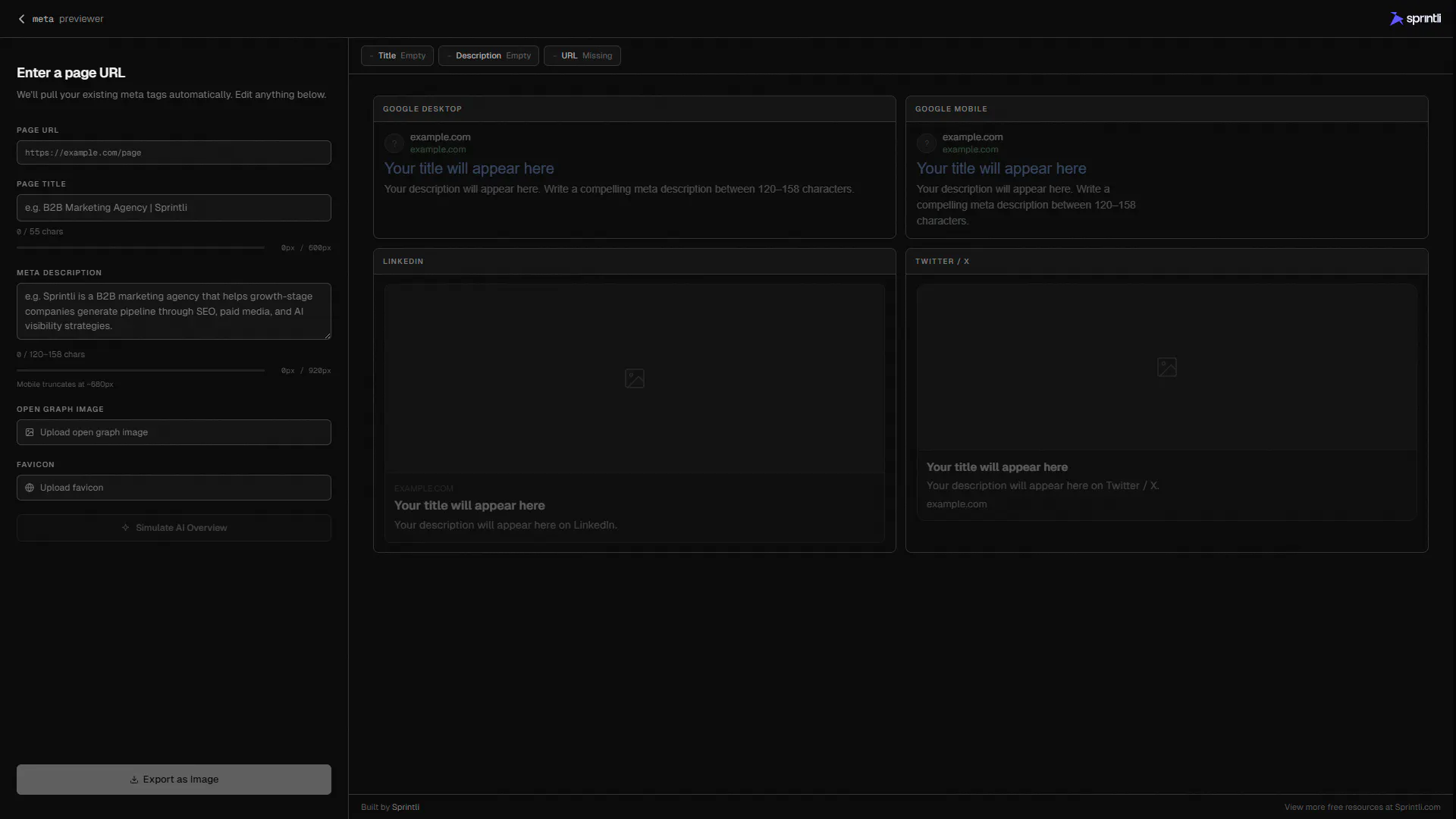
Stop guessing how you look to bots. Use our Meta Previewer to simulate your Search Generative Experience appearance and AI Overview citations.
A Google SGE Review: What Changed in 2026?
A comprehensive Google SGE review reveals that the "traditional" top 3 results no longer guarantee the most traffic. AI Overviews often pull from sources further down the page if those sources provide better-structured data or clearer "Answer Nodes."
In our Google SGE review of 150+ client accounts, we found that sites with high SGE SEO scores shared three traits:
- Semantic Clustering: They didn't just target one keyword; they owned the entire "Topic Universe."
- Schema Density: They used our Schema Generator to tell the AI exactly what each paragraph meant.
- Direct Answer Formatting: They utilized "Snippet-Friendly" headers that the Search Generative Experience could easily "chunk."
How to Rank in Google SGE: The Optimization Playbook
If you are asking how to rank in Google SGE, you are asking a question about Entity Authority. You cannot "trick" a generative model with backlinks alone.
Step 1: Execute SGE SEO Audits
You cannot optimize what you haven't measured. SGE SEO audits involve checking your "Entity Health." Does Google recognize you as an expert in your niche?
- Audit Tip: Use our LLM Generator to see if AI models can accurately describe your services. If they hallucinate, your SGE SEO foundation is broken.
Step 2: Structure for Extraction
To master how to rank in SGE, your page must treat data as "Machine-Readable."
- The Lead-In: Follow every H2 with a 40-word "Direct Answer."
- The Evidence: Use tables and bulleted lists. SGE SEO prioritizes structured formats because they are easier for LLMs to parse and cite without error.
Understanding the SGE SERP Dynamics
The SGE SERP is a hybrid environment. On the left, you have the AI Overview; on the right, you have the "Carousel" of cited links.
Winning in the SGE SERP means appearing in that Carousel. This requires more than just Search Generative Experience SEO; it requires Brand Authority. If your brand is mentioned across LinkedIn, Reddit, and high-tier industry publications, the Search Generative Experience is significantly more likely to trust your URL as a citation source.
Advanced SGE in SEO Tactics
For 2026, SGE in SEO has moved into the "Hyper-Niche" phase.
1. Intent Node Mapping
We no longer look for "High Volume" keywords only. We look for "Trigger Clusters"—phrases that force the Search Generative Experience to generate a response. By targeting these triggers, you ensure your brand is present at the "Moment of Generation."
2. Conversational Continuity
Users now "chat" with the SGE SERP. Your content must answer the next question they are likely to ask. This "Follow-up Optimization" is a core pillar of how to rank in Google SGE.
Search Generative Experience SEO: The Future of B2B SaaS
For B2B SaaS, Search Generative Experience SEO is the only way to shorten the buyer journey. If the AI can explain your pricing, your features, and your ROI directly in the SGE SERP, the "Lead" that eventually clicks through is 10x more qualified.
This is why we prioritize SGE SEO audits for every new partner. We identify where your "Information Gaps" are allowing competitors to steal the AI's "Voice."
Don't let the AI age leave your brand behind. Schedule an SGE SEO Audit with Sprintli and dominate the next generation of search.
