

If you are looking for what strategies improve brand visibility in AI search engines, you have to look beyond the surface level. The "game" of SEO hasn't fundamentally changed—it has simply added layers of complexity. While the basics (high-quality content, site speed, and backlinks) still matter, AI business context strategic visibility requires moving beyond traditional tactics into a realm of "data corroboration" and "semantic authority."
1. The Fallacy of AI SEO Tools and Checkers
Many founders ask: Can I just use AI SEO tools for visibility optimization or AI search visibility checkers to fix my rankings?
The short answer? No.
Most current AI search visibility checkers and AI tools for Google Business Profile optimization provide a few basic recommendations—like adding schema or using specific headers—but they lack the high-level strategic nuance required to drive true results and ROI. They are basic "check-box" tools. They can tell you if your site is somewhat readable and contains a few minor SEO elements, but they cannot tell you if your website is optimized or if your brand is trusted by the Large Language Models (LLMs).
To move the needle, you need to adapt a holistic strategy that bridges the gap between traditional search and AI discovery. Understanding the nuances between SGE, AIO, AEO, and GEO is the first step in moving past these AI tools and toward true model influence.
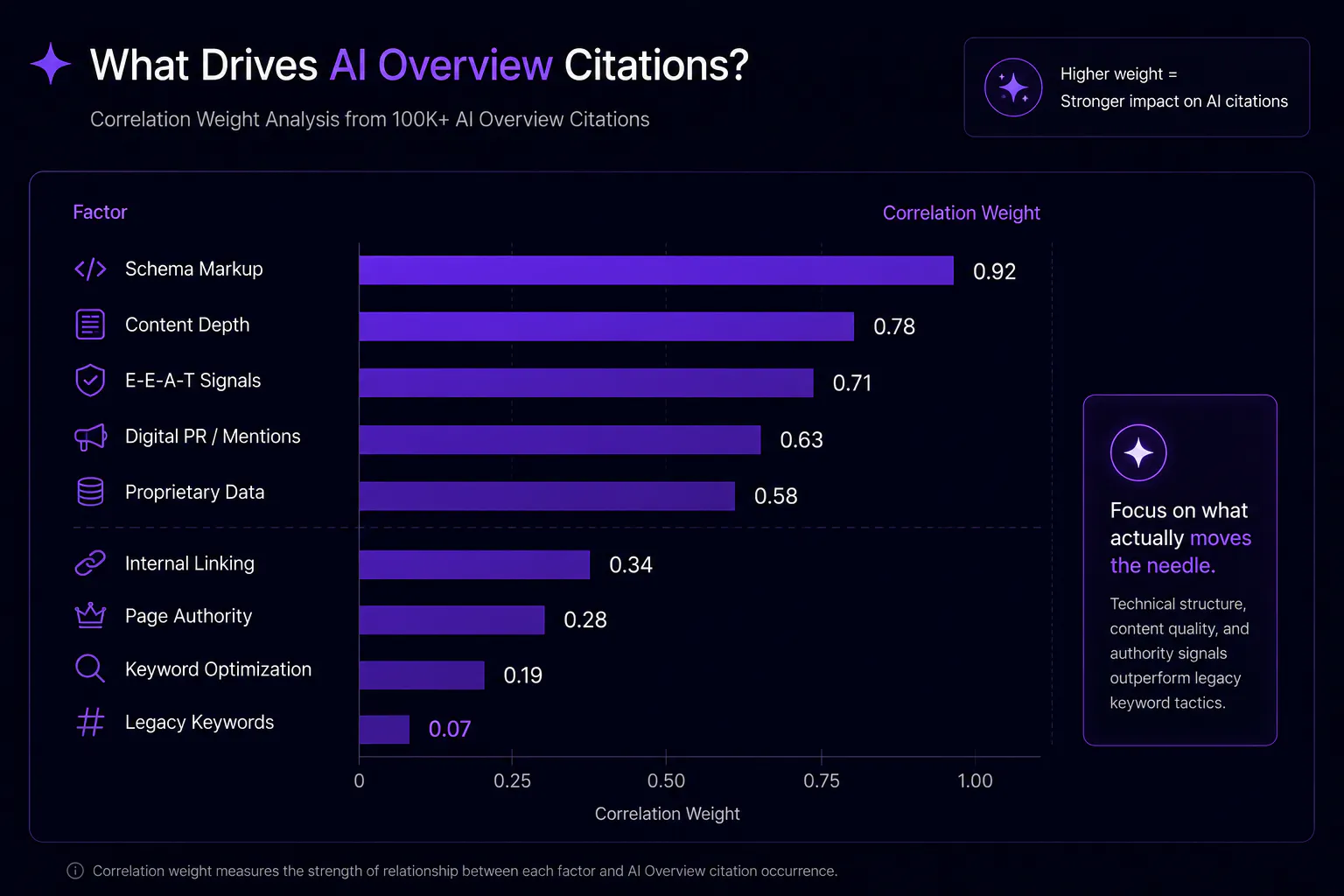
Relying purely on basic AI SEO checkers that only grade keyword density is a massive strategic mistake. Real-world data tracking across thousands of Google AI Overviews shows that the algorithms prioritize technical structure and trust over basic keyword matching, highlighting three critical baselines:
- The Schema Advantage: Pages utilizing advanced structured data (schema markup) are cited 2.1x more often in AI Overviews than pages without it.
- The E-E-A-T Multiplier: Sources displaying clear author profiles, credentials, and verifiable brand information are cited 1.8x more often than anonymous content.
- The Content Depth Metric: The average length of a cited source is 2,100+ words, with in-depth pillar content cited 3x more frequently than short articles under 1,000 words.
2. Core Strategies: How to Improve Brand Visibility in AI Search Engines
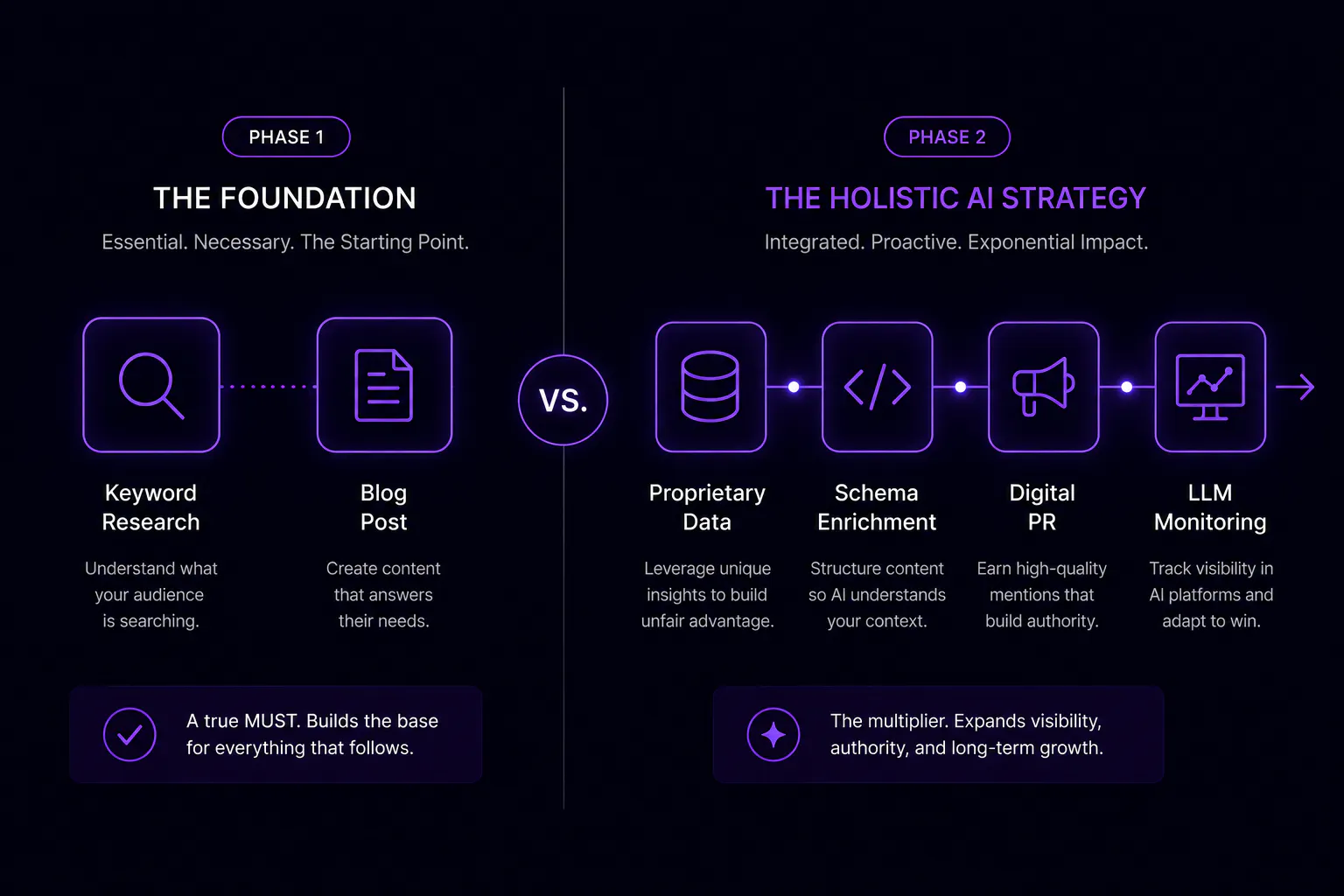
To have a presence in generative answers, you need to go from "Ranking" to "Being the Source". This doesn't mean ignoring traditional keywords or rankings—those remain your essential starting blocks for search—but true model authority requires building upon that foundation until you become the definitive origin point the AI has to cite.
A. Building AI Business Context
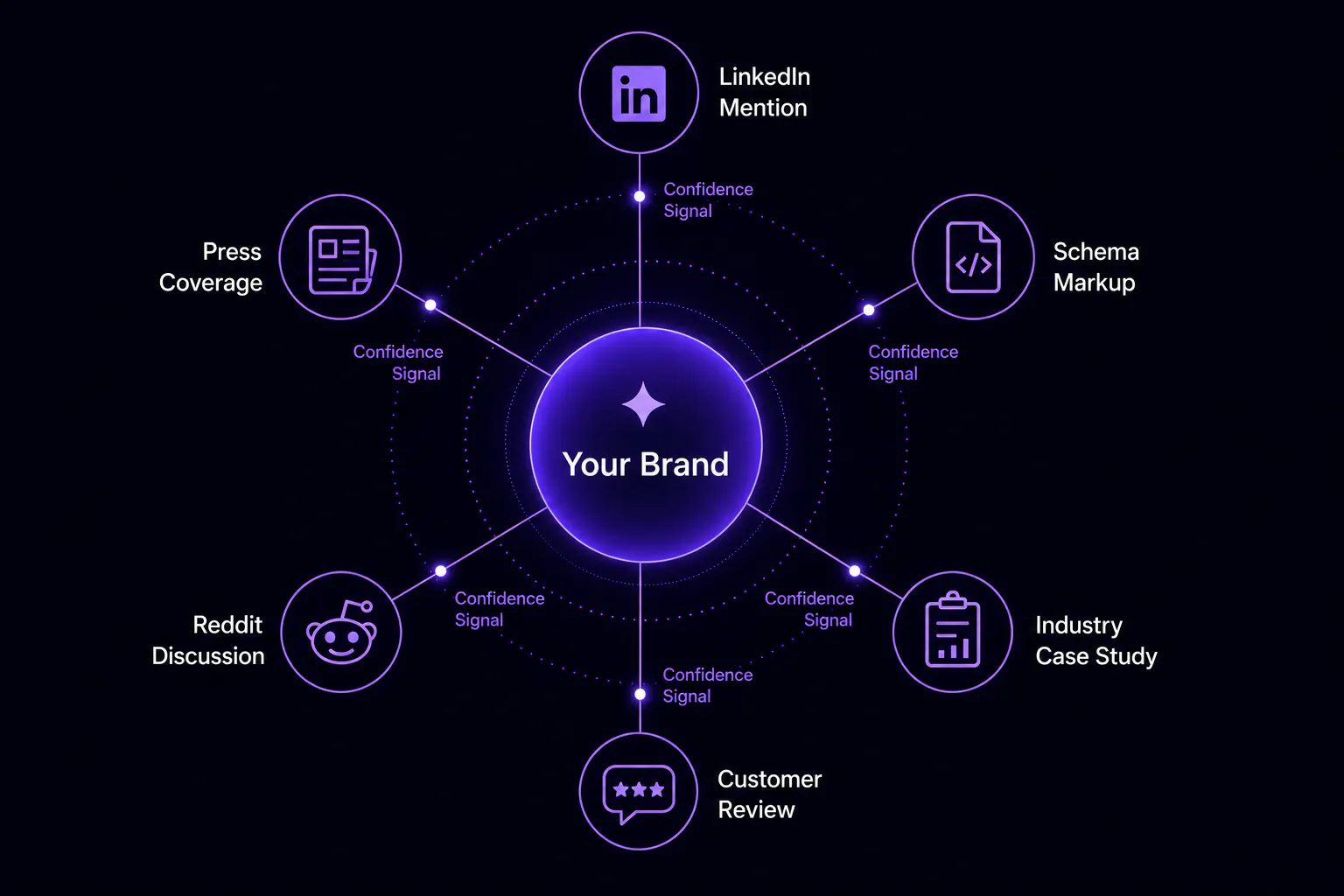
AI models operate on a "Knowledge Graph." If your brand is mentioned only on your own website, the AI considers that a biased claim. To achieve AI business context strategic visibility, your brand must be corroborated across the "Digital Commons."
- The Strategy: Invest in Digital PR and high-authority placements rather than purchasing cheap link packages. Don't buy backlinks; earn them.
- The reality is simple: Google knows when links are manufactured. Buying poor, artificial backlinks doesn't just fail to move the needle—it directly damages your reputation with Google’s core algorithms.
When an AI sees your brand mentioned in the same context on TechCrunch, LinkedIn, and Reddit, it builds a high-confidence association. - The Goal: Architect a system of search engine marketing intelligence that captures demand by showing up everywhere the AI looks for validation.
B. Semantic Data Enrichment (Beyond Keywords)
AI search engines use vectors to determine relevance. They aren't looking for a string of text; they are looking for entities and relationships.
- The Strategy: Use our Schema Generator to implement "About" and "Mentions" nodes in your JSON-LD. This explicitly tells the AI: "This article is about [Service] and mentions [Brand] as a leader in [Niche]."
C. Information Gain and Proprietary Data
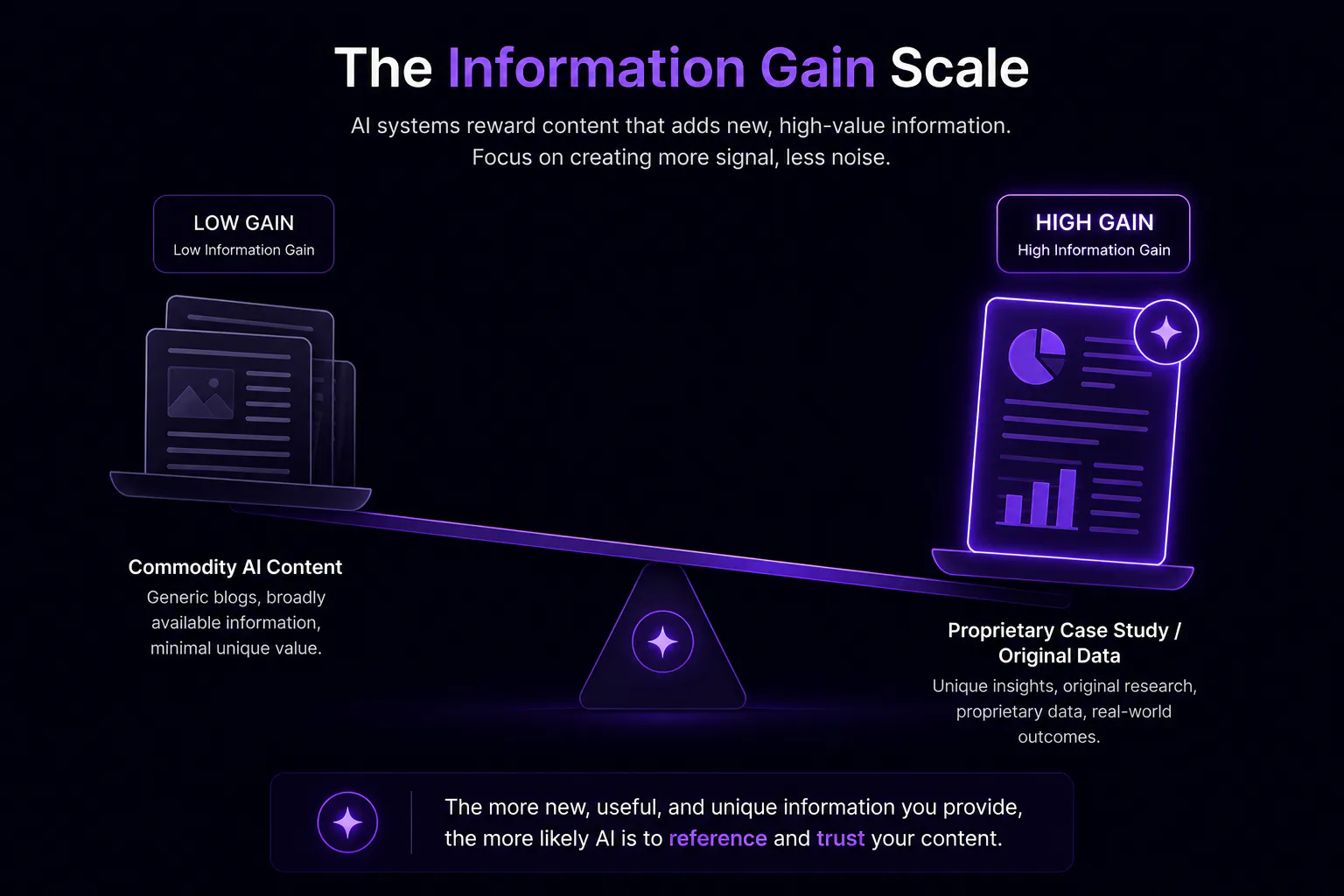
LLMs are trained to avoid redundancy. If your blog post is just a rehash of the top 10 results on Google, an AI has no reason to cite you.
- The Strategy: Accelerating E-E-A-T Through Information Gain. Publish original research, unique case studies (like our Flychain results), or proprietary frameworks.
Traditional on-page basics and standard content checklists are your entry fee; they are the starting blocks for establishing Google’s E-E-A-T framework. But true AI optimization requires you to build upon that baseline.
Information Gain is the single highest "visibility signal" for modern AI engines. Mastering SGE SEO dominance depends entirely on being a unique, cited source that brings real-world experience and fresh data to the table, rather than just being another ranking URL that repeats the same commodity facts.
3. The Information Gain Gap: Why "Good" Content is No Longer Enough
One of the primary reasons most AI seo tools for visibility optimization fail is that they encourage users to write for a "score" rather than for "freshness." In the AI era, if your content does not provide Information Gain, it is invisible to a Large Language Model.
What is Information Gain?
Information Gain is a measure of how much new information a piece of content brings to the existing corpus of data the AI has already been trained on. If you write a "What is SEO" guide that says the same thing as Wikipedia, the AI has zero incentive to cite you. It already knows that information.
To improve brand visibility in AI search engines, you must close the Information Gain Gap by producing:
- Primary Research: Data sets, surveys, or experiments conducted by your brand.
- Contrarian Frameworks: Challenging the industry "status quo" with a unique, repeatable methodology—much like our Search Intelligence Framework.
- Technical Deep-Dives: Explaining the "how" and "why" of complex processes, not simply the "what".
The "Commodity" Trap
Most normal users use AI seo tools to generate content. This creates a loop of “average” information. Because the AI tool is trained on existing data, it can only produce more of the same. When you publish this, the AI search engine recognizes it as redundant.
Good, informative content is the entry fee for search visibility. If your blog provides the standard facts, you've successfully reached the baseline. However, a blog post is just the starting point; you must now build upon that foundation with proprietary research to cross the citation threshold.
At Sprintli, we go beyond this by identifying "Knowledge Voids." We look for the questions that AI models are currently answering poorly or with outdated data, then we create the definitive, data-backed answer that forces the model to update its "context" and cite our clients as the new authority. This is the essence of SGE SEO dominance.
4. The Role of an AI Search Monitoring Platform
You might wonder, how can an AI search monitoring platform improve SEO strategy?
While we’ve warned against relying on basic "checkers," a sophisticated monitoring platform serves as an early-warning system. It identifies "Share of Model"—how often your brand is the default recommendation for a specific problem.
At Sprintli, we don’t just look at a static rank. We integrate several custom tracking options on our own platforms to see how AI sentiment shifts over time. This data allows us to pivot your content strategy before your competitors even realize their traffic is dropping. We monitor how the models are synthesizing your brand data so that you continue to be the “Preferred Answer” in a world where the “Blue Link” is becoming an artifact.
5. Realistic Expectations: Why Specialists are the New Requirement
At the end of the day, "normal people" can try to optimize their own content for AI. They can follow a checklist, use a few ai seo tools, and tweak their headers. But they shouldn't be surprised if they see zero improvement in ROI.
Anyone can lay a solid foundation by following SEO basics, but in 2026, the technical complexity creates a professional ceiling. Think of your content as a high-quality engine; it’s a great start, but specialists are required to tune, maintain, re-optimize, and scale that engine so it is prioritized by the models that matter.
It’s the same game, only with bigger stakes. More steps, more technical checks, a higher bar to entry for “Authority”. The basics still matter, but if you want to dominate AI, you’ve got to go beyond. You need specialists in the “hidden layers” of LLM training data and semantic intent.
Tired of "check-box" SEO? See how Sprintli builds real AI Visibility.
Ready to dominate the search results of 2026? Contact Sprintli Studios today.
